A Democracy Without Anchors
Dealignment and The Age of Cynicism
American politics is usually described as polarized: two sides moving farther apart, institutions under attack, voters sorted into hostile camps.
But polarization is only part of the story. Something deeper has changed. The institutions that once anchored people in political life—parties, unions, churches, civic organizations, local media, and public systems—no longer hold people in the same way.
People still care. They still vote, argue, protest, follow the news, and organize in moments of crisis. But many no longer believe the institutions asking for their trust can deliver. CARD calls this condition dealignment. And the way it feels is cynicism.
What Is Dealignment?
In political science, dealignment usually refers to the weakening of durable attachments between voters and political parties.
CARD uses the term more broadly. Dealignment is the erosion of durable attachments to the institutions that once organized political participation, identity, legitimacy, and belonging.
That includes parties. But it also includes unions, congregations, local newspapers, civic associations, neighborhood organizations, public agencies, and movement groups.
These institutions were never perfect. Many were exclusionary, unequal, and contested. But they performed important political functions. They gave people places to return to. They translated everyday experience into shared political meaning. They created relationships that made disagreement survivable.
As those institutions thin, politics becomes more episodic, fragmented, and filtered through distrust.

The Attachments Have Thinned
Dealignment is not caused by one election, one candidate, one party, or one platform.
It is the result of decades of social and institutional change.
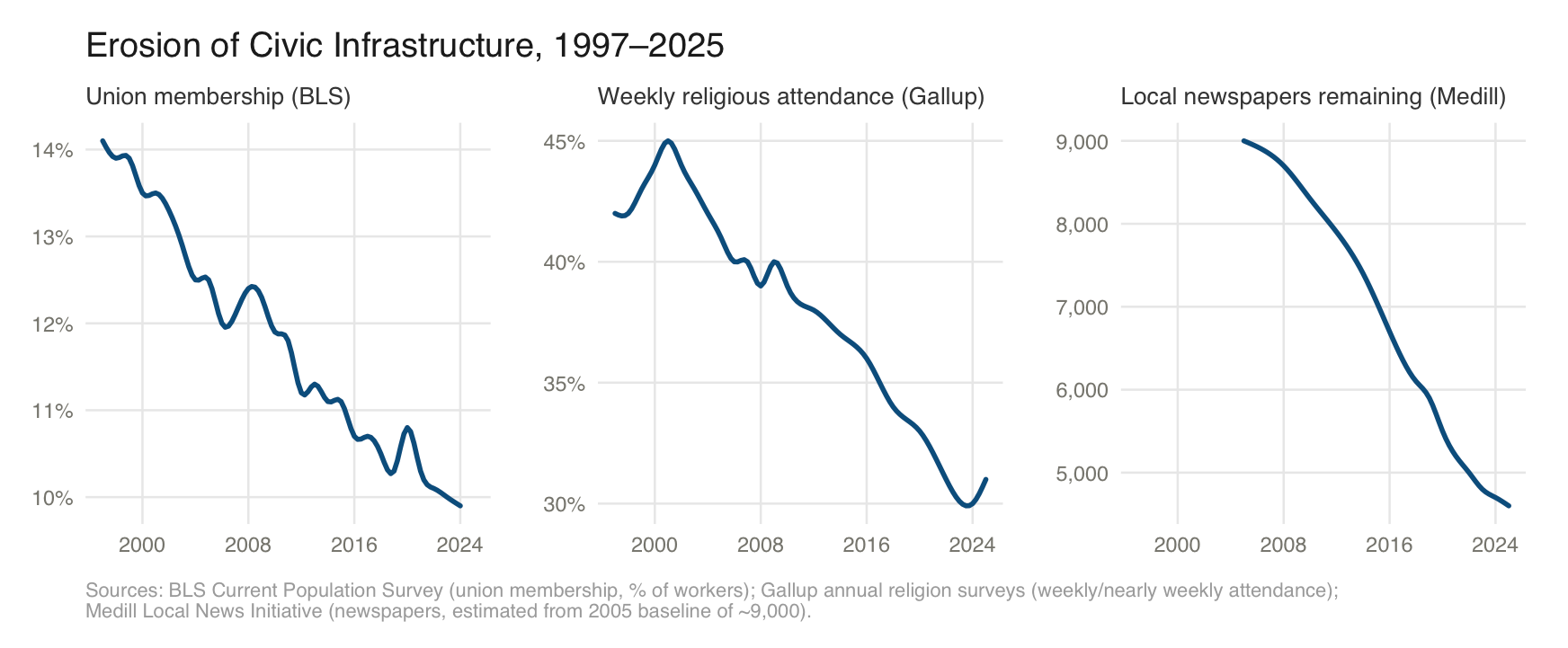
Union membership has fallen dramatically from its mid-twentieth-century peak. Local newspapers have disappeared from communities across the country. Religious attendance and affiliation have declined. Housing instability and time scarcity have weakened local rootedness. Public systems are often experienced as opaque, burdensome, and unreliable.
Together, these changes have altered how people encounter public life.
Fewer people experience politics through institutions they return to week after week.
More experience it as a series of episodic asks: vote, donate, share, volunteer, defend, resist.
Cynicism Is Not Apathy
A few weeks before an election, there is a knock at the door. The conversation is polite and familiar: the cost of rent, the price of groceries, the state of schools, the need to protect democracy. Nothing in the exchange is implausible. But underneath it sits a quiet, practiced doubt. The listener has heard versions of this before. Maybe they have spent hours trying to untangle a benefits application, fought with a hospital bill, watched a promised reform stall out, or seen leaders return only when they need votes. What lingers is uncertainty about whether engaging again will make any difference.
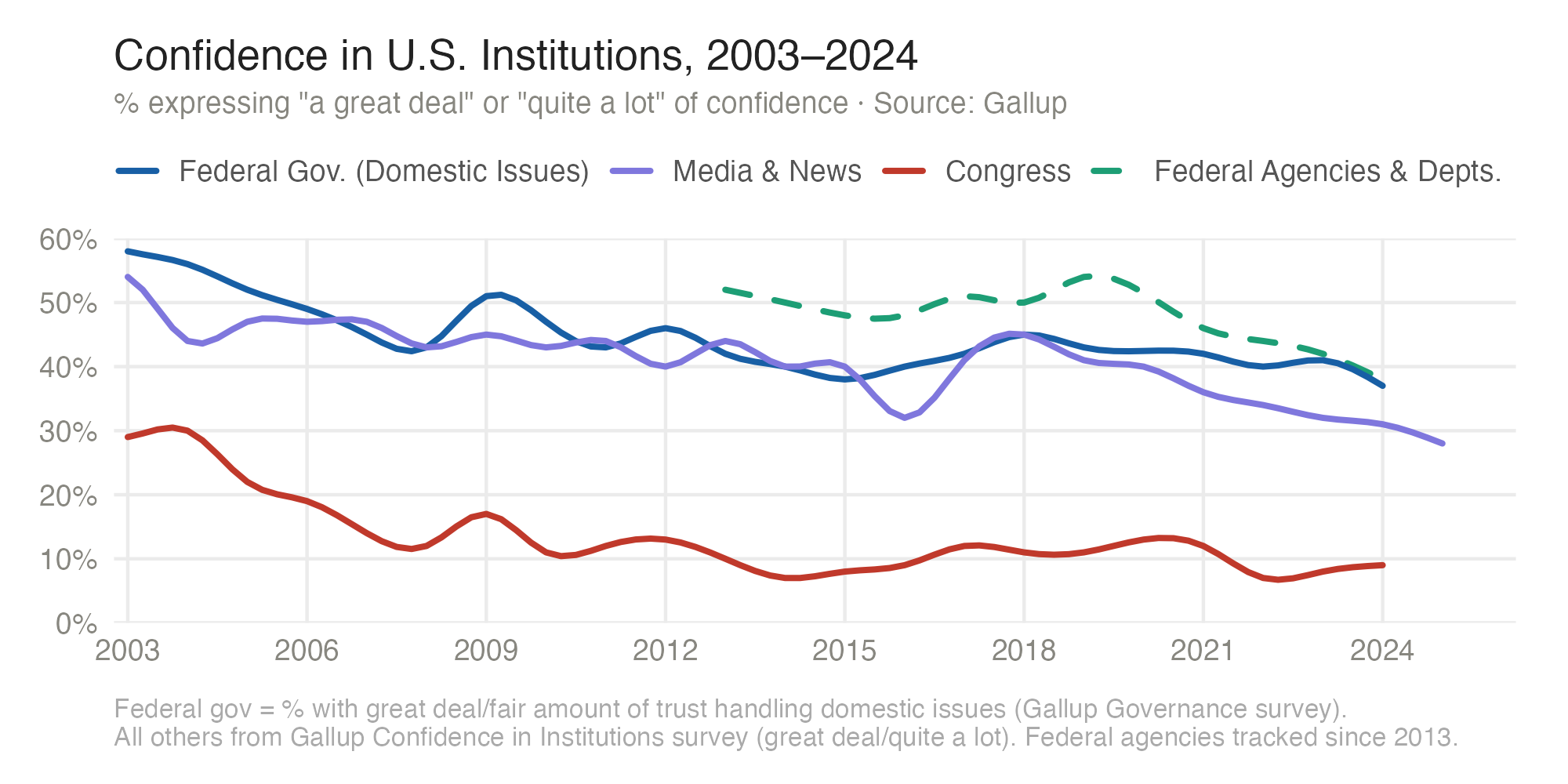
Cynicism is the lived experience of dealignment: the learned expectation that institutions will not respond.
The loss of faith in institutions cannot be explained solely by misinformation or digital manipulation. It grows from lived experience, and those experiences are not uniform. For many Black Americans, distrust emerges from a long history of exclusion and unequal treatment. For trans people, cynicism reflects ongoing hostility and erasure within public systems. For young people, it arises from a lifetime of observing systems that largely fail to provide them with stability or dignity.
Cynicism, then, is a rational adaptation to a world in which institutional attachment has grown fragile and public promises have repeatedly outpaced lived experience.
The Strategic Mistake
Much of the pro-democracy field still operates as if institutional legitimacy can be taken for granted.
It often assumes that people trust expertise. That constituencies are stable. That issue agreement will produce durable support. That better messaging can overcome weak attachment. That defending democracy will resonate because democratic institutions are already experienced as worth defending.
These assumptions no longer hold reliably.
Many strategies were built for a more aligned political era.

What Comes Next
The answer is not nostalgia. Many of the institutions that once anchored political life were unequal, exclusionary, and contested. We should not try to recreate the past.
But the functions they performed still matter.
Interpretation.
Continuity.
Accountability.
Belonging.
The ability to hold disagreement without immediate exit.
The work ahead is to build new forms of political life that can perform these functions in a changed world.
That means political homes: spaces where people can return, argue, build trust, develop leadership, and experience democracy as something real.

CARD’s flagship report, A Democracy Without Anchors: Dealignment and the Age of Cynicism, offers a framework for understanding why familiar strategies are producing fragile results and what it will take to rebuild democratic life in a low-trust era. The task ahead is not just to defend democracy as it is. It is to rebuild the conditions under which democracy can be lived and sustained.